Fireweed Ivan Chai: The Wild Tea Growing Around Us

Updated: Aug 21
Fireweed, transformed through the Ivan Chai tradition.

Some teas arrive from far away, wrapped in stories of mountain gardens, mist, and long trade routes.
Others have been growing quietly in the landscapes we already call home.
Fireweed Ivan Chai belongs to the second kind.
It begins with fireweed—Chamaenerion angustifolium—a familiar northern plant that rises along forest edges, open meadows, riverbanks, trails, and sunlit clearings throughout British Columbia.
In northern B.C., fireweed is part of the summer landscape. Its tall stems and pink-purple flowers appear across hillsides and open ground, returning wherever the land makes room for light.
Most people know the plant as fireweed.
Far fewer know what its leaves can become.
Through the old Ivan Chai tradition of withering, rolling, oxidizing, and drying, fireweed leaves are transformed into a dark, smooth, full-bodied tea—naturally caffeine-free, deeply aromatic, and surprisingly reminiscent of a traditional black tea.
It is an old tradition made from a plant that has been growing around us all along.

A wild tea that is not quite tea
Fireweed, a hardy northern plant also known botanically as Epilobium angustifolium, though Chamaenerion angustifolium is now widely accepted.
It is called tea because of how it is prepared and enjoyed. Botanically, however, it isn't traditional tea. Black tea, green tea, oolong, white tea, and pu-erh all come from the same plant: Camellia sinensis. What distinguishes those teas is largely what happens to the leaves after they are harvested.
Fireweed is something different. The plant contains no caffeine, yet its leaves can be transformed into a dark, full-bodied infusion with remarkable depth. That is what makes Ivan Chai so intriguing. The leaves are gathered, softened, rolled, oxidized, and dried. Through this process, something happens that is difficult to imagine when looking at a fresh green fireweed leaf.
The grassy character recedes. Colour deepens. Aroma develops.
The resulting tea can be surprisingly reminiscent of black tea—warm, rounded and substantial—while remaining distinctly its own.
Fireweed Ivan Chai is not trying to imitate black tea. It is what happens when fireweed is given the time and attention to become tea in its own way.
Tea is not only a plant. It is a practice of paying attention.
The tradition behind Fireweed Ivan Chai
The practice of making Ivan Chai has deep roots in Eastern Europe and Russia, where fireweed has long been gathered and prepared as a herbal tea. One traditional style is often referred to as Koporye tea, associated historically with the Russian village of Koporye.

Before imported teas became widely accessible, locally gathered plants played an important role in everyday life. Fireweed could be harvested during the growing season, transformed, dried, and stored for the months ahead.
Much of this knowledge was carried through practice rather than formal instruction:
Knowing when to gather.
Knowing how the leaves should feel.
Knowing when the scent has changed.
Knowing when the leaves have transformed enough to be dried.
These are small acts of observation. And like many traditional foodways, the knowledge survived because people continued to make it. Imported teas eventually became more accessible, and local tea traditions became less visible. But Ivan Chai never entirely disappeared. The tradition remained in homes, villages, and wild landscapes. Today, it is finding its way back into attention.
Fireweed has been growing around us all along
There is something particularly fitting about making tea from fireweed in northern British Columbia. Fireweed is a plant of return. It is often among the plants that appear following wildfire and other forms of disturbance.
Its seeds travel on fine, silky hairs, carried by the wind into newly opened spaces.

Then it grows. Tall stems rise from the ground. Flowers open. Colour returns.
For those of us living in northern B.C., fireweed can become almost ordinary. It grows beside highways and trails. It appears near cabins, fields and cutblocks. It stands in ditches and along riverbanks, its flowering stalks following the summer upward.
But familiarity can make us overlook things. That is part of what draws me to fireweed.
The plant doesn't need to come from somewhere exotic to be worthy of attention. It is already here.
It carries the character of northern summer—the long light, cool mornings, open ground and resilient landscapes.
The wild tea growing nearby is not lesser than tea from somewhere far away. It simply carries a different story. It carries this place.
The making of Fireweed Ivan Chai
The transformation begins with the harvest. Fireweed leaves are gathered thoughtfully, taking care not to strip an area bare and leaving plenty of flowers and growth behind.
Then the work begins.

Withering
Fresh fireweed leaves are full of moisture and have a bright, green character.
Withering allows that moisture to gradually leave the leaf. The leaves soften and become more pliable. Their scent begins to change—the sharpness of fresh greenery gives way to something softer and warmer.
Rolling
The softened leaves are rolled and bruised. This breaks down the leaf structure and releases its juices, creating the conditions for the next stage of transformation.
Traditionally, this could be done by hand, rolling leaves between the palms. The process is simple, but important. The leaf has to be opened.
Oxidation
The rolled leaves are allowed to rest while oxygen interacts with the compounds within the plant. The green, grassy aroma changes. It becomes deeper. Warmer. Sometimes fruity or floral. The length and conditions of oxidation influence the finished tea, from lighter and more herbal to darker, rounder and more substantial. The process is sometimes referred to as fermentation in traditional Ivan Chai making. In tea terminology, oxidation is the more precise description.
Drying
Finally, the leaves are dried to stop the transformation and preserve what has developed. The finished leaves become dark, twisted and fragrant. What began as a green leaf has become something entirely different.
The difference between dried fireweed and Ivan Chai is transformation.
What Fireweed Ivan Chai tastes like
This is usually where people become curious—because the finished tea doesn't taste quite like what they expect from a wild herbal infusion.
Brewed properly, Fireweed Ivan Chai produces a rich amber to reddish-brown liquor. The aroma is warm and rounded rather than sharply grassy.
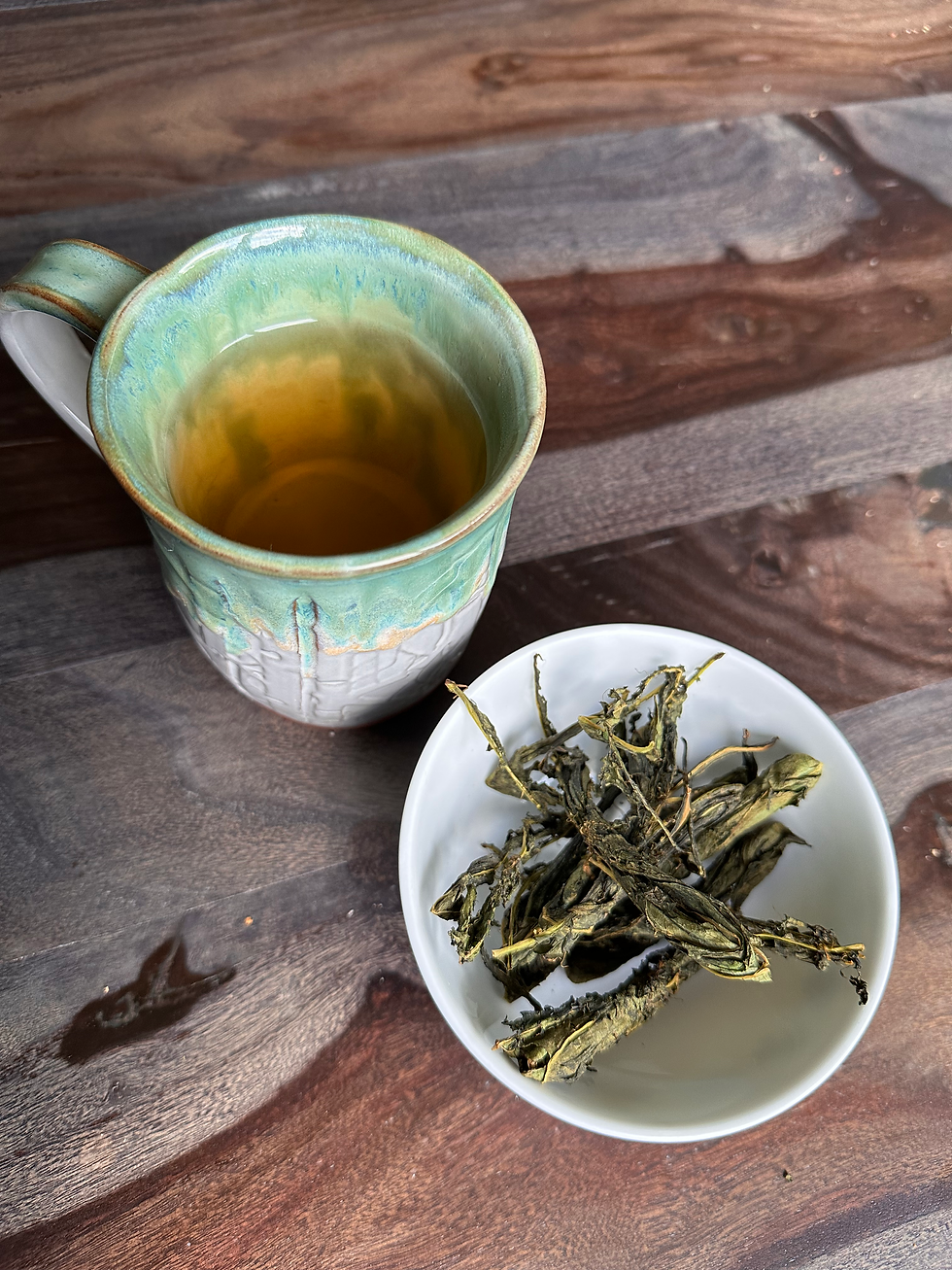
Taste
The first sip is smooth. Then the body settles in. Depending on the harvest and processing, you may find notes reminiscent of:
Honey
Warm grain
Soft hay
Dried fruit
Meadow flowers
Gentle earth
There is no added flavouring. No caffeine. No need for sugar.
And unlike some black teas, it can have a remarkably gentle finish without a pronounced tannic dryness. It has presence without demanding attention. That makes it especially suited to quiet mornings, evenings after dinner, or a pot shared around a table.
A different kind of evening tea
There was something about Fireweed Ivan Chai that made me think differently about what a tea could be. I had spent years thinking about tea through the traditions of Camellia sinensis—green tea, oolong, black tea, pu-erh. Then there was fireweed.
A plant I already knew. A plant growing in northern British Columbia. A plant that could be transformed into something with the depth and warmth I was looking for, without caffeine.
The first cup was quiet. Dark leaves. Hot water. A fragrance somewhere between forest, grain and kitchen.
It tasted familiar without being familiar. Smooth. Rounded. Naturally sweet. Grounded.
And it raised a larger question:
How many meaningful rituals are sitting just outside our attention?
The more I learned, the more the pieces came together. The plant. The Eastern European tradition. The patience of the process. The landscape where the fireweed grows. And the simple pleasure of making a cup at the end of the day.
That became part of the inspiration for Sip Ritual. Not the idea of discovering something new—the idea of noticing something that was already here.

Returning to a forgotten leaf
Fireweed Ivan Chai begins as a wild northern plant. It becomes tea through patience, touch and time. It carries an old tradition from Eastern Europe while growing here in the landscapes of British Columbia.
And in the cup, it offers something simple:
Warmth without caffeine
Depth without heaviness
A reason to slow down for a few minutes
At Sip Ritual, Fireweed Ivan Chai isn't presented as a new discovery. The fireweed was already here. The tradition already existed. The knowledge of transforming the leaf has been carried for generations.
What we are doing is bringing those threads together in our own small way.
A northern plant. An old tea-making tradition. A slower way of drinking. That is Fireweed Ivan Chai.
And perhaps the next time you pass a hillside covered in fireweed, you'll see it a little differently. Not simply as a flower, but as a leaf with another life waiting inside it.

Comments